

Types of Borescopes: Flexible, Rigid, and Video Borescopes Explained
If you have started shopping for an inspection camera, you have probably noticed that the word borescope gets attached to a confusing range of tools — from cheap USB cameras on a cable to rigid optical scopes that cost thousands of dollars. Before you compare specs or prices, it helps to understand the different types of borescopes and how each one actually works. This guide breaks down the three main categories — rigid, flexible, and video borescopes — explains the trade-offs of each, and shows you which type fits the kind of inspection you need to do.
What a borescope does
A borescope is an optical or digital tool that lets you see inside spaces that are otherwise sealed, cramped, or unsafe to reach: an engine cylinder, a wall cavity, a section of pipe, a gearbox, a turbine, or a firearm barrel. Every borescope combines three things — a way to get a lens or camera to the target, a light source, and a way to view the image. How those three parts are built is exactly what separates one type of borescope from another.
The main types of borescopes at a glance
| Type | How the image is formed | Best suited for | Main limitation |
|---|---|---|---|
| Rigid borescope | A straight tube with a fixed optical lens system | Straight-line access, high-detail optical inspection | Cannot bend around corners |
| Flexible borescope (fiberscope) | A bundle of optical fibers carries the image along a bending tube | Curved or winding paths where a screen is not required | Lower resolution; visible fiber pattern |
| Video borescope | A digital camera chip at the tip sends the image to a screen or phone | Most modern inspection work, recording, and sharing | Image quality depends on the sensor and optics |
Rigid borescopes

A rigid borescope is a straight, non-bending tube that uses a series of precision glass lenses to relay an image from the tip back to an eyepiece or camera. Because the optical path is fixed and made of glass, rigid scopes have traditionally offered the sharpest, most distortion-free image of any borescope type.
The trade-off is obvious in the name: the probe does not bend. A rigid borescope only works when there is a reasonably straight line of sight to whatever you need to inspect.
Rigid borescopes are a good fit for:
- Inspecting machined parts, castings, and bores on a production line
- Firearm barrels and chambers
- Hydraulic and pneumatic cylinders
- Any job where access is straight and image sharpness matters most
Where they fall short: anything with a bend, an offset, or a winding path. If the camera has to turn a corner to reach the target, a rigid scope cannot get there.
Flexible borescopes (fiberscopes)
A traditional flexible borescope, often called a fiberscope, replaces the rigid glass lens train with a bundle of thousands of thin optical fibers. Each fiber carries one point of the image, so the picture can travel along a probe that bends and snakes through curved passages.
Fiberscopes solved the problem of reaching around corners long before digital cameras were small enough to fit on a probe tip. Their weakness is resolution: the image is only as detailed as the number of fibers in the bundle, and you can often see a faint honeycomb or grid pattern across the picture. They also tend to be more fragile and more expensive to repair, since a broken fiber shows up as a permanent dark spot.
Fiberscopes still make sense for:
- Winding or curved paths where you look through an eyepiece rather than a screen
- Specialized or legacy setups already built around fiber optics
For most everyday inspection work, though, this style has largely been replaced by the digital option below.
Video borescopes
A video borescope puts a tiny digital camera sensor and an LED light right at the tip of a flexible probe. Instead of relaying the image through glass or fiber, it sends an electronic signal back to a built-in screen, a monitor, or a smartphone or tablet app. This is the type most people mean today when they say “inspection camera,” and it is the category Ralcam builds.
Video borescopes combine the reach of a flexible probe with the clarity, brightness, and convenience of a digital display. Because the image is already electronic, they can record photos and video, zoom, adjust lighting, and share footage — things an optical scope simply cannot do.
Typical strengths of a video borescope:
- Live view on a screen or phone, so more than one person can watch
- Photo and video capture for documentation and customer approval
- Bright, adjustable LED lighting built into the tip
- Flexible probes that reach around bends, with waterproof options for oily or wet spaces
Articulating vs. non-articulating video borescopes

Within the video category, the biggest distinction is whether the tip steers. A standard flexible probe bends when you push it, but you cannot aim it once it is inside. An articulating borescope adds a steerable tip — usually controlled by a joystick — that you can point up, down, and side to side while the probe is in place. Two-way articulation moves the tip along one axis; four-way articulation lets you sweep in every direction.
Articulation matters when you need to inspect a specific surface that the probe would otherwise slide right past — the far wall of a cylinder, the back of a turbine blade, or a weld seam inside a pipe. For simpler straight-in jobs, a non-articulating video borescope is lighter, simpler, and more affordable. We weigh the two against each other in detail in our guide to articulating vs non-articulating borescopes.
Features worth checking on a video borescope
- Probe diameter and length — determines what openings you can enter and how far you can reach (see our probe diameter guide)
- Camera resolution — how much detail you can actually resolve on screen
- Dual or side-view lenses — useful for seeing walls, not just what is straight ahead
- Waterproof rating — needed for inspecting inside engines, drains, or fluid-filled spaces
- Display or app — a built-in screen versus a phone connection changes how you work
We cover how to weigh these against each other in our borescope buyer's guide, and you can line up exact specs side by side on our borescope comparison page.
Which type of borescope is right for your job?
Matching the type to the task is more important than chasing the highest number on a spec sheet. As a starting point:
- Automotive and engine work (cylinders, intake ports, transmissions): a flexible video borescope, ideally waterproof, and articulating if you need to inspect cylinder walls closely.
- HVAC, plumbing, drains, and wall cavities: a flexible video borescope with a longer probe and a bright light.
- Machined parts, firearm barrels, and straight bores: a rigid borescope for maximum optical sharpness — or a slim video scope when you also want to record.
- Turbines, welds, and complex industrial cavities: an articulating video borescope so you can aim the tip at the exact surface.
See Ralcam borescope cameras
Ralcam designs and manufactures digital video borescopes directly from our factory in Shenzhen, focused on giving professionals and serious DIY users a reliable inspection camera without the markup. If your work centers on engines and vehicles, browse our automotive borescope cameras. For manufacturing, maintenance, HVAC, and general trade work, see our industrial borescope cameras.
Still deciding on probe size, length, and resolution? Start with our guide to how to choose a borescope, read our buyer's guide, and compare models on the comparison page to find the borescope that matches your job.
Looking for the right borescope?
Browse the full Ralcam range — industrial and automotive inspection cameras for every job.
Shop all borescopes →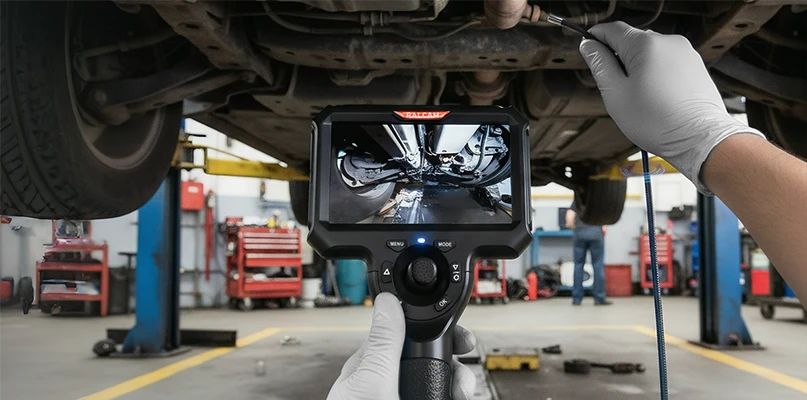
Leave a comment