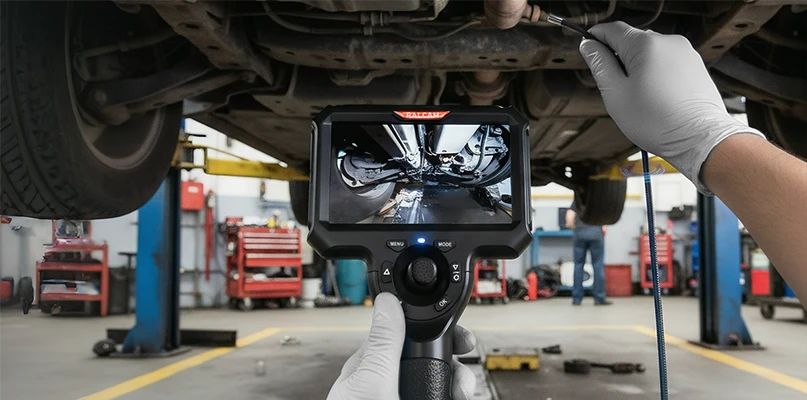
Borescope Buyer's Guide — How to Choose the Right Inspection Camera
Borescope Buyer's Guide: How to Choose the Right Inspection Camera
Choosing the right borescope can be the difference between a 10-minute diagnosis and a 3-hour teardown. This guide helps you match the right tool to your job — whether you're a mechanic, plumber, HVAC technician, or industrial inspector.
What Is a Borescope?
A borescope is an optical instrument with a miniature camera at the tip of a flexible or semi-rigid probe, used to inspect confined spaces that can't be reached by eye or hand. The terms borescope and endoscope are often used interchangeably for industrial tools. At Ralcam, we manufacture both under one roof and ship factory-direct — which means professional-grade precision without the distributor markup.
Step 1 — Choose Your Use Case
| Use Case | Recommended Type | Key Spec |
|---|---|---|
| Engine cylinder / valve inspection | 2-Way or 4-Way Articulating | Probe ≤6.2 mm, semi-rigid cable |
| Spark plug hole access (gasoline) | 2-Way or 4-Way Articulating | Probe 3.9–6.2 mm, 1 m cable |
| Diesel / truck engine | 2-Way Articulating | Probe 6.2–8.5 mm, 1–3 m cable |
| HVAC evaporator coil cleaning | Cleaning Borescope | Built-in cleaning nozzle |
| Pipe / drain / plumbing | Semi-rigid push-rod | Probe 5.5–8.5 mm, 1–3 m cable |
| Wall cavity / home inspection | 2-Way Articulating | Flexible cable, built-in screen |
| Weld / crack / NDT inspection | 4-Way + UV | UV LED, IP67, 8.5 mm probe |
| Aviation / turbine / industrial | 4-Way Articulating | 4-way joystick, 5" screen |
Step 2 — Screen vs. Smartphone Connection
Borescope with Built-In Screen
Best for professionals who need both hands free, shop environments, and field inspections without a phone. Models like the F606B, N505, and M6X have dedicated 3.5"–5" IPS screens, TF card recording, and operate completely stand-alone.
USB and Smartphone Borescope
Best for occasional use, lighter carry, or when you want to view on a large phone screen and share images instantly. Models like the F408A and H406A connect via USB-C or Lightning and work with iOS and Android — a wired connection, so there is no pairing or signal to drop.
Step 3 — 2-Way vs. 4-Way Articulation
2-Way articulating borescopes steer up and down using a thumb wheel or damping knob. They handle the large majority of engine and pipe inspection tasks and are more compact and affordable. See the 2-Way Articulating series.
4-Way articulating borescopes add independent left/right control alongside up/down, giving you full 360° navigation around corners without repositioning the probe. Worth the cost for aviation turbine inspection, complex cavities, and NDT work. See the 4-Way Articulating series.
For a deeper look at how the bending section works and exactly when 4-way earns its price, read What Is an Articulating Borescope?
Step 4 — Probe Diameter
- 3.9 mm — tightest access; fits small-displacement gasoline spark plug holes. Available on the F606B.
- 5.5 mm — good general purpose; fits most automotive and HVAC ports
- 6.2 mm — the all-round standard; wider field of view and brighter image
- 8.5 mm — maximum light and image quality; diesel cylinders, industrial pipes, large access ports
Measure your smallest access hole before ordering — resolution is no help if the probe will not fit.
Step 5 — Cable Type
- Flexible cable — follows bends and gravity; best for drains, ducts and general routing
- Semi-rigid cable — holds the shape you give it; pre-bend it to clear an obstruction and it stays put. Ideal for engine bays and horizontal pipe runs
- Rigid tube — straight-line access only
Frequently Asked Questions
What probe diameter fits a spark plug hole?
Most gasoline engines have a spark plug access bore of roughly 12–14 mm. A 3.9 mm to 6.2 mm probe fits comfortably with room to maneuver. The Ralcam F606B (3.9 mm / 6.2 mm) and F408A (5.5 / 6.2 / 8.5 mm) are purpose-built for this application.
What is the difference between 2-way and 4-way articulation?
A 2-way borescope steers in one plane (up/down). A 4-way steers in both planes independently. For engine cylinder inspection, a 2-way is usually sufficient. For aviation turbine blades or complex industrial cavities, 4-way control lets you navigate around obstructions without withdrawing the probe.
Is IP67 waterproof enough for engine bays?
Yes. IP67 means the probe head withstands engine oil, coolant spray, water ingress from wet pipes, and condensation in HVAC systems. Note that the rating covers the insertion tube and camera head — keep the display and handle dry.
Can I use a borescope on both gasoline and diesel engines?
Yes. Gasoline engines benefit from a 3.9–6.2 mm probe. Diesel engines are more accessible with a 6.2–8.5 mm probe. The Ralcam N308S ships in 6.2 mm and 8.5 mm variants and covers both.
Do I need articulation at all?
For straight pipes and direct-access cavities, a non-articulating semi-rigid borescope is faster and simpler. For any inspection point that requires looking around a bend or sideways at a cylinder wall, articulation is essential.
Compare Every Model
Want the specs side by side instead? The full comparison table lists articulation, probe diameter, screen, resolution and battery for every Ralcam model in one view.